

Fascination, injuries & lack of time management
My history with Brazilian Jiu-Jitsu
I have been fascinated by martial arts for over 35 years. Starting with Thai boxing, my passion continued to develop over the years – until I arrived at Brazilian Jiu-Jitsu (BJJ) around the year 2000. The sport is technically demanding, physically challenging and mentally extremely demanding. For me, BJJ was always more than just ground fighting. It was strategy, body control, precision – a real game of chess on the mat. I trained for many years with total dedication – under really good teachers and participants and under the umbrella of the world’s largest association, Gracie Barra. And despite all the enthusiasm, I had to realize: This sport has its price.
What makes BJJ so special – and so stressful
Brazilian Jiu-Jitsu works with leverage and choking techniques. The aim is to force the opponent to give up, without strikes, only through control. This control is based on biomechanical principles, precise technique, perfect timing – and enormous physical exertion. Those who train BJJ roll. And those who roll, fight. Even in training.
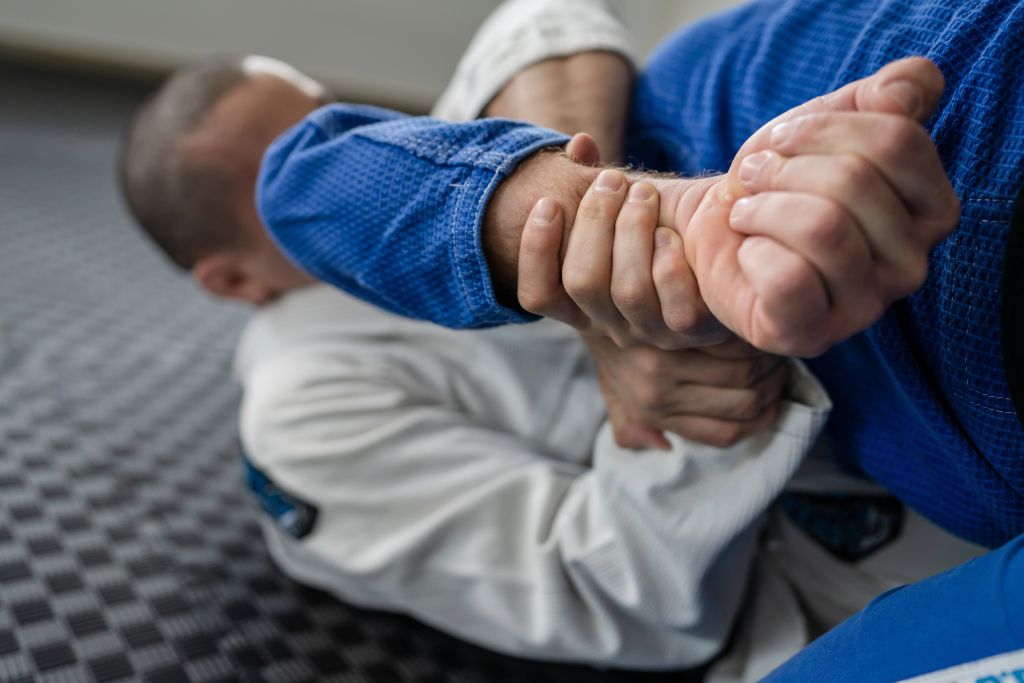
Sounds harmless? In fact, BJJ carries a risk of injury that should not be underestimated due to precisely these leverage effects and intensive loads – especially if there is no compensatory training.
My injuries – not an isolated case
Over the years, I have suffered various injuries: broken ribs, a torn collateral ligament in my knee, a shoulder injury and recurring problems with my spine.
If you look around in forums, videos or studies, you will come across the same typical injuries again and again:
- Rib fractures due to compression in the roll
- Knee injuries due to twisted joints during takedowns or submissions
- Shoulder instabilities with armbars or kimuras
- Neck and back problems due to overstretching, constant tension and pressure
- Overload syndromes in fingers, wrists and elbows
Many of these injuries are not caused by gross negligence alone. There are often two factors: too hard, ego-driven rolling that pushes the body beyond its limits, and a poor training structure. If, on the other hand, the training plan is structured sensibly and the athlete is gradually introduced to higher loads, the musculoskeletal system is perfectly capable of coping well with intensive and hard sessions.
The injuries to my spine were particularly drastic for me. They not only forced me to take long breaks from training, but also affected my entire life: I could barely sleep at night, couldn’t turn or stand up without pain. Even everyday activities such as walking, sitting or driving became torture. The large number of painkillers I had to take during this time to cope with the extreme pain also affected my stomach and digestive tract. And the worst part: no doctor could help me.
The problem: lack of compensatory training
A typical BJJ session lasts around 90 minutes. Around 15-20 minutes of this is spent on warming up, a bit of mobilization – followed by technique training and “rolling”, i.e. sparring. The focus is on grappling, control, and submission holds. What is often missing is targeted training for:
- Joint stability
- muscular balance
- Flexibility
- Mobility
- Torso stability
- Regeneration
What a dancer does every day – stretching, coordination, balance – is hardly addressed in BJJ. Even many highly qualified professors openly admit this: Their programs leave neither time nor space for this. And not infrequently: know-how.
Why BJJ can be particularly dangerous – especially for “desk offenders”
The real problem is not the sport itself – but the combination of everyday stress and training structure. Anyone who sits in the office during the day and throws themselves into 90-minute BJJ sessions three times a week in the evening risks a biomechanical imbalance. Especially if strength, flexibility and regeneration are neglected.
There is also the age factor. Mobility and muscle strength naturally decrease with age, while recovery times become longer. Work and family often make a regular training routine even more difficult. If you then compete unprepared against much younger and more athletic opponents, you expose yourself to an increased risk of overloading and acute injuries. What initially begins gradually – tension, pain, minor strains – adds up over weeks and months to serious problems that do not always become apparent immediately, but sometimes much later.
My conclusion after 35 years: BJJ needs balance
Brazilian Jiu-Jitsu is one of the most fascinating sports I know. And I have been passionate about it for decades. But I also know that if you want to practise BJJ long-term and injury-free, you need more than just technique.
I therefore always recommend it – even to myself:
- 2 additional units per week for strength, mobility and stabilization
- Targeted exercises for areas prone to injury: Back, hips, shoulders and knees
- Consciously plan for regeneration
Every body reacts differently – but if you’re not prepared, you’ll overstretch yourself. That’s why I now help many BJJ athletes to prepare themselves holistically: With individual strength training, mobility and smart load control.
Make an appointment now
Do you train BJJ and want to be healthier, more stable and injury-free on the mat?
Then get in touch. I will help you to improve your BJJ game sustainably – without paying the price of overwork.
You can also book a consultation with me here:
Train smart. Roll smooth. Stay healthy.