

Systematic deception – the art of feinting in boxing
Introduction
In boxing, it is often not the hardest punch but the smartest move that decides whether you win or lose. If you trick your opponent into reacting incorrectly, you can land the decisive hit at the right moment. This is exactly where a key technique comes into play: the feint. But what makes feints so effective? What forms are there? And when are they particularly effective in combat?
The following summary is based on a comprehensive analysis of Olympic boxing matches – and is aimed at anyone who wants to better understand the strategic core of boxing. Newcomers in particular will be surprised at how much brains are behind this supposedly raw sport.
What is a feint – and why is it so important?
A feint is a deliberately used deceptive action with which a boxer tries to trick his opponent into an inappropriate reaction – for example, moving the wrong way, blocking where no punch is coming, or leaving a supposedly safe position.
In contrast to a pure striking technique, a feint is a tactical measure. It is not executed with the aim of hitting immediately, but to provoke a reaction to which a targeted response is then made. You could say that the feint is a lure, not the bite.
Example from practice
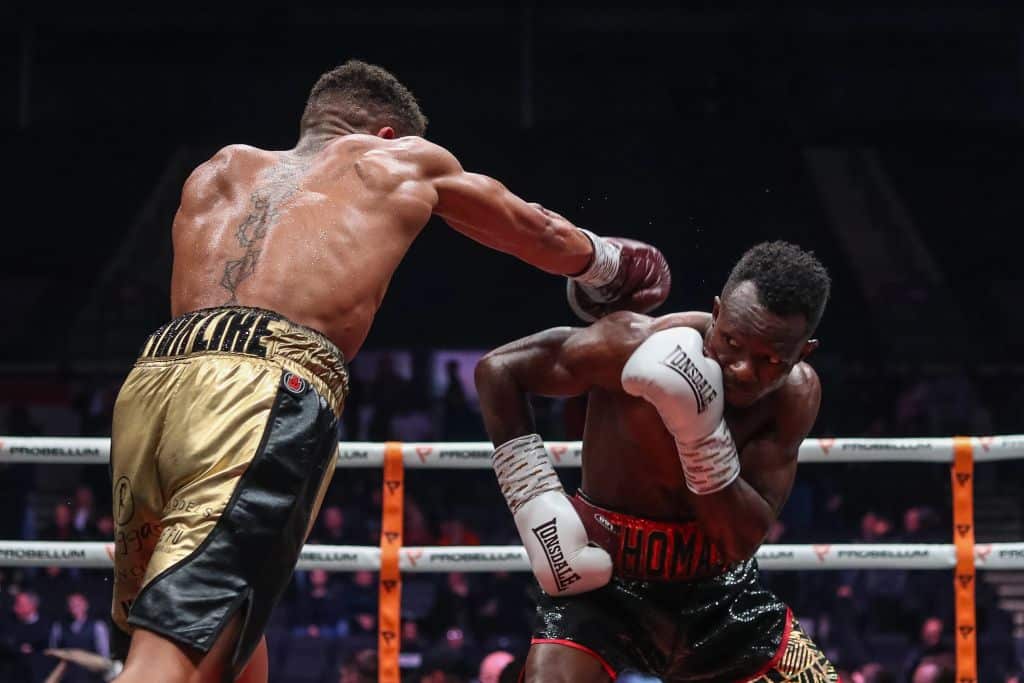
A boxer feints a jab – the opponent raises his guard. At this moment, the body opens up and the actual punch hits the open flank with full force.

The different types of feints
In the analysis of the 2000 Olympic Games in Sydney, feints were divided into three main areas – each with subcategories:
- Simple feints
- With your legs (e.g. half forward or backward step)
- With the torso (e.g. diving, dodging)
- With the arms (e.g. suggestion of a blow, slight shoulder movement)
- Combined feints
- Combinations of leg movement + torso action
- Or leg movement + punch arm deception
- Or all three together
- Variable combined feints
- Changing, unpredictable combinations of deceptive actions that vary in rhythm, intensity and direction.
Why this distinction is important
Simple feints are easier to learn, but also easier to see through. Combined and, above all, variable feints require more coordination, body control and timing – but are much more effective in combat.
Book a consultation now
When are feints particularly effective? The right time counts.
A key finding of the study is that it is not only the type of feint that is decisive, but also its timing in the fight.
The evaluation of the fights in Sydney revealed:
- The longer a fight lasts, the more frequent and effective feints are.
- Winners increase the intensity and variability of their feints later in the fight.
- In the first round, people tend to analyze – in the last rounds, they deceive.
Why is that?
In the initial phase of a fight, boxers try to “read” their opponent. Tricks are usually used here to gather information: How does the opponent react to a certain move? Does he block early? Does he stay calm? Can he be lured?
Only when these patterns are recognized do targeted feints come into play – combined with effective follow-up actions.
Note:
Feint = analysis + control + stroke preparation
Tricks in the context of training: when should you start learning them?
Many beginners believe that feints are only for professionals. The truth is: feints can be integrated into technique training right from the start, because they train:
- Perception and anticipation
- A sense of rhythm and beat control
- Footwork and balance
- Tactical thinking and variability of action
A simple way to get started: first learn a feint with the upper body – e.g. a dive without a follow-up action. Then combine the movement with a real attack. As soon as you feel confident, you can practise combined feints step by step – such as a half forward step with a simultaneous arm pull.
In my personal boxing training in Hamburg, I work specifically with visual stimuli, series of punches with built-in illusions and real reaction exercises that are also immediately practicable for beginners.
Those who can feint win more often – and smarter
The analysis of the Olympic fights has shown it in black and white:
- Winners use significantly more feints than losers
- Boxers who vary their feints – i.e. who do not always use the same rhythm, the same direction or the same part of the body – are particularly successful.
- Boxers in heavier weight classes also use feints more often – presumably because they operate with less speed and therefore have to rely more on deception and timing.
Another exciting result: the winners vary their feints more than their opponents from round to round. This shows that successful boxers remain unpredictable. They “break their patterns” in a targeted manner – exactly what many beginners avoid because they become fixated on individual techniques.
Not all feints are the same: national differences in style
A particularly exciting part of the analysis was the consideration of national differences in the use of feints:
- The American school relies heavily on explosive individual actions and lightning-fast deceptions.
- The Cuban school often combines feints with dancing footwork and perfect timing.
- The Russian and Ukrainian schools, on the other hand, rely increasingly on tactical feints with long build-ups and variable combinations.
- Kazakh boxers showed a mixture of clear structure and surprising changes of direction.
Even if you are not part of a national system as an amateur boxer, it is worth learning from these styles. My personal boxing training therefore incorporates elements from all schools – adapted to your individual movement patterns and your goals.
Conclusion: feints are the key to smarter boxing
Feints are not just a gimmick – they are the decisive factor for tactical control, psychological superiority and technical maturity.
You…
- help you to read and manipulate your opponent,
- open up opportunities that would never arise without deception,
- make you more unpredictable and dangerous – even if you are physically inferior.
And the best thing is: you don’t have to be a professional to work with feints. Even as a beginner, you can learn them – systematically, suitable for everyday use and directly applicable.
Book a consultation now
Your next step: Learn to deceive. Master striking.
If you want to experience boxing not just physically, but strategically – then Your Boxing Coach is the right place for you. In my personal boxing training in Hamburg, you won’t just learn how to punch – but when, how and why.
We take your fitness to a new level – and your tactical thinking along with it.
Train smarter. Deceive better. Hit more accurately.