

From 35: Why belly fat is not just annoying, but your metabolic life insurance
Belly fat. It’s what we see in the mirror and makes us feel uncomfortable. But what many middle-aged Hamburgers don’t know: That “annoying belly fat” is not just an aesthetic problem. It is a clinically relevant health issue.
Especially after 35, managing your visceral fat becomes crucial to your quality of life, your energy and your long-term health – whether you’re a man or a woman. As a personal trainer here in Hamburg-Altona, I see clients every day who struggle with this problem but often use the wrong strategies.
In this article, we’re going to dispel the myths and reveal the scientific truth about losing weight on your stomach. And I’ll show you how we put this knowledge directly into practice for you in our training and nutrition programs.
The scientific truth: visceral vs. subcutaneous fat
Let’s put the myth to rest here: You can’t burn fat in a specific part of your body. Fat loss is a global process of the body, controlled by a calorie deficit and your hormones. But there is a crucial difference that you need to understand:
- Visceral fat: This is the fat that accumulates around your internal organs (such as the liver and intestines) in the abdomen. It is metabolically extremely active and the actual “dangerous” fat. It is the main driver of inflammation, type 2 diabetes, cardiovascular disease and metabolic problems. That is the goal!
- Subcutaneous fat: The fat just under the skin that you can “pinch”. It is metabolically more inactive and more of an aesthetic concern.
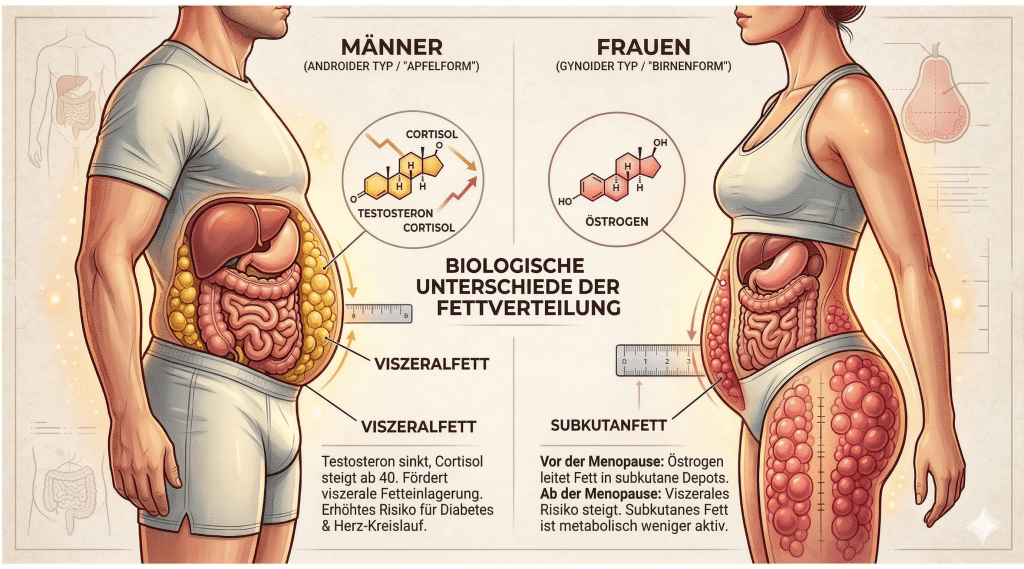
What the science says: A recent comprehensive meta-analysis (the strongest form of scientific evidence) by Lopez et al (2022) consistently confirms that supervised exercise programs and the combination of strength training and a calorie deficit are most effective in reducing this dangerous visceral fat.
The 3 pillars of fighting belly fat: your battle plan
Pillar 1: Nutrition (your fuel & hormone tuning)
The calorie deficit is unavoidable, but it is not the whole truth. In order to burn fat and not lose muscle, we need to optimize hormone control and nutrient supply.
- The “expert hammer” – micronutrients: Calorie reduction alone is like an engine without ignition.
- Zinc: Essential building block for testosterone production (men) AND hormonal regulation (post-menopausal women). A deficiency causes the body to become catabolic – it holds on to fat and breaks down muscle.
- Magnesium: Involved in over 300 enzyme reactions, especially in ATP energy production. Without magnesium, you feel tired because the body cannot efficiently release energy from the fat cells.
Pillar 2: Training (the engine that burns fat & protects muscles)
We need a training stimulus that metabolically activates the metabolism.
- The “blast furnace effect” of muscles: Muscles are metabolically active tissue. More muscle means a higher basal metabolic rate – even at rest.
- The power of the afterburn effect (EPOC): Intense workouts like HIIT make sure you burn even more calories hours after your workout to recover.
- Muscle preservation: Science shows that only strength training during a calorie deficit protects valuable muscle mass and stops sarcopenia (muscle atrophy with age).
Pillar 3: Lifestyle (stress management & sleep)
Chronic stress and lack of sleep massively release cortisol (the stress hormone). Cortisol is an antagonist of testosterone and oestrogen and a real muscle eater. It signals to the body: “Keep the fat as an emergency reserve”. Your training in Hamburg-Altona must therefore be a building stimulus, not an additional stress stimulus.

Why strength training is a necessity in midlife
From midlife onwards, strength training goes from being a “nice-to-have” to an absolute necessity:
- Hormonal tuning: From 35, testosterone (men) and oestrogen (women) decline. Strength training is the most natural way to stimulate hormone production, maintain muscles and ensure drive and libido.
- Fighting sarcopenia (muscle wasting): Without training, the body loses massive amounts of muscle mass. Our training stops and reverses this process, which increases the basal metabolic rate and keeps “belly fat” in check.
- Metabolic health: Strength training drastically improves insulin sensitivity and is the best protection against type 2 diabetes and age-related heart disease.
My offer: Why nutrition & training should come from a single source (In Hamburg-Altona)
- The control unit: Nutrition turns on the energy supply, but training is the stimulus that tells the body what to do with this energy (muscle building vs. fat storage). Without control over both, we don’t know where the calories are going.
- Hormonal balance: Hard training with a lack of nutrients drives your hormonal system up the wall (cortisol trap). In my 3-month package, I make sure that training is a build-up stimulus and not a stress stimulus.
- Avoid flying blind: Increased strength during training is the first signal as to whether the diet is right. This saves us months of trial and error.
Finally get rid of that annoying belly fat: Appointment for personal training
If you finally want to get rid of that annoying belly fat and are ready to let science work for you, then I invite you to a free trial training session in our professionally equipped gym in Hamburg-Altona. See for yourself how we use the mechanisms of HIIT, martial arts, strength training and strategic nutrition to achieve sustainable results. Secure your place now!
Make an appointment now
Source reference:
Lopez, P., et al. (2022). Effects of resistance-based exercise programs on body composition in individuals with overweight or obesity across the lifespan: A systematic review and meta-analysis. Obesity Reviews, 23(5), e13428. doi:10.1111/obr.13428. Available at: https://onlinelibrary.wiley.com/doi/10.1111/obr.13428