

How the roots of modern boxing still shape your training today
My everyday life between sandbag, sparring and stopwatch
For almost ten years, (combat) sport has been my main job. And honestly, I realize every day that it’s more than just a job. During the day, I work intensively with my personal training clients in the gym – from entrepreneurs who want to clear their heads to managers who want to boost their self-confidence. In the evenings, I run my classes, which bring together both amateur athletes and ambitious competitors. And at the weekend? I’m often in the ring with my protégé, who recently became the Hamburg boxing champion.
Regardless of the athletes’ goals, I deal with very different people – from beginners to experienced athletes who want to squeeze out the last two percent. They are all united by the desire for change: better fitness, stress reduction and more presence in everyday life.
What I realized in the process: Everyone needs a different approach. Sometimes empathy is required, sometimes a clear edge. The balancing act between motivation and excessive demands is my daily bread.
When “the more the better” was still the training plan
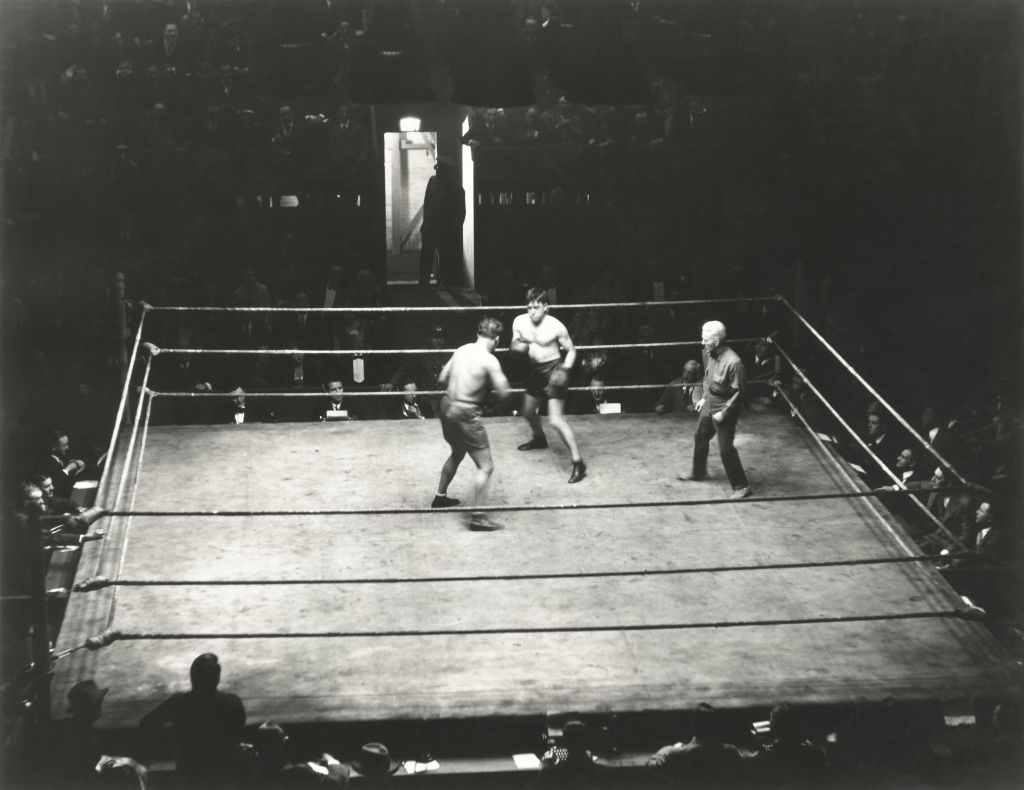
When I started boxing, the world was a different place. Training theory and regeneration hardly played a role. The principle of toughness applied: training six days a week, no matter how tired you were. Hard sparring was the norm, even if your head was already ringing after five rounds. Room for health protection? Not a chance.
And yet this era produced legends: Jack Johnson, Jack Dempsey, Joe Louis, Sugar Ray Robinson, Muhammad Ali, Joe Frazier, George Foreman and Roberto Duran. They didn’t have GPS watches or neuro-drills – but they had technique, timing and a lot of heart.
If you rummage through old books and come across a “boxing bible”
Martial arts has been my passion for more than three decades. I am fascinated not only by the present, but also by the roots of the sport. Recently, I came across a work that many refer to as the “boxing bible”: “The Complete Boxer” by J. G. Bohun Lynch (1914).
The fascinating thing: The most important fundamentals have not changed to this day. Other areas have been completely raised to a new level by modern science and neuroscience.

Timeless basics: what is still worth its weight in gold today
1. the lead hand – the king’s stroke (and your tool for focus)
Lynch writes: “The straight left to the head is the best of all punches.” He means the jab – and he’s right. The jab is the center of your game:
- Distance control: You decide who can get how close.
- Line of sight interruption: A modern jab not only disrupts the rhythm, it also briefly blocks the opponent’s view in preparation for the power shot.
- Error detector: Every reaction of the opponent to your jab reveals gaps.
This ability to recognize patterns under pressure also helps you in meetings when you need to make clear decisions.
2. stance & balance – your foundation for power
Lynch attached great importance to the basic position. My credo for two decades: Balance = Power + Defense. If you have a bad stance, you can neither hit hard nor dodge cleanly. For this reason, balance exercises are an integral part of my training sessions – my participants can tell you a thing or two about it.
- The link to life: If you are stable in the ring, you gain presence. This inner stability helps you when you come under pressure at work. We build a bridge between sport and life: confidence in the ring leads to confidence in negotiations.
3. boxing as a sport of character and mind
Lynch saw boxing as a school of character: discipline, courage and respect. Today we call this executive functions (impulse control & decision-making skills). Boxing not only shapes the body, but is an intervention for mental health – it makes you more resilient and present.
Where the “boxing bible” reaches its limits: modernity
While the technical basics remain the same, the methodology is now light years ahead:
- Smart periodization: Instead of “always full on”, we now use cycles. We train more explosively, use rotational strength and pay attention to targeted regeneration.
- Brain health: We cultivate skill, not pain tolerance. Hard sparring is replaced by technical and situational sparring to minimize the risk of long-term injuries (CTE). Good equipment such as thick gloves, head protection and shin pads provide additional protection against injury.
- Scientific weight loss & nutrition control: To this day, athletes suffer from radical dehydration and starvation diets just before the fight. However, we know: This not only destroys performance, but is life-threatening. As a certified nutritionist, I take a different approach: scientific weight loss. Instead of using aggressive methods, we rely on planned, individually coordinated nutritional strategies. We use our knowledge of macronutrient cycles and fluid balance to achieve your target weight with pinpoint accuracy – while maintaining full energy levels and maximum health.
Old-school vs. new-school: the four kings of today
Let’s take a look at how today’s world-class boxers combine the knowledge of 1914 with the science of today:
- Vasiliy Lomachenko: He trains his brain like a punching hand. He uses complex coordination drills and number puzzles under physical stress to maximize his cognitive speed.
- Oleksandr Usyk: He uses playful reflexes and juggling to sharpen his visual perception. His footwork is pure efficiency – a modern interpretation of Lynch’s demand for light-footedness.
- Dmitry Bivol: A master of distance. He uses modern strength and conditioning plans to maintain a mechanical precision over 12 rounds that punishes every mistake his opponent makes.
- Terence Crawford: He combines the heart of the old school with an extremely high fighting IQ. His stance-switching is the evolution of the classic elementary school.
Make an appointment now
What does that mean for your training?
- Keep the basics sacred. Lead hand, stance, sense of distance – that is your foundation.
- Train your nervous system. Use neuro drills (e.g. reaction games with color stimuli) to get faster in your head, not just in your fists.
- Protect your head. Swap pointless lumbering for technical sparring with clear tasks.
- Combine old-school heart with new-school know-how. Be tough in discipline, but smart in planning.
Finally, something practical: 👉 If you’re unsure whether your technique is right, talk to me during training or write to me – I’ll be happy to help you. 🥊